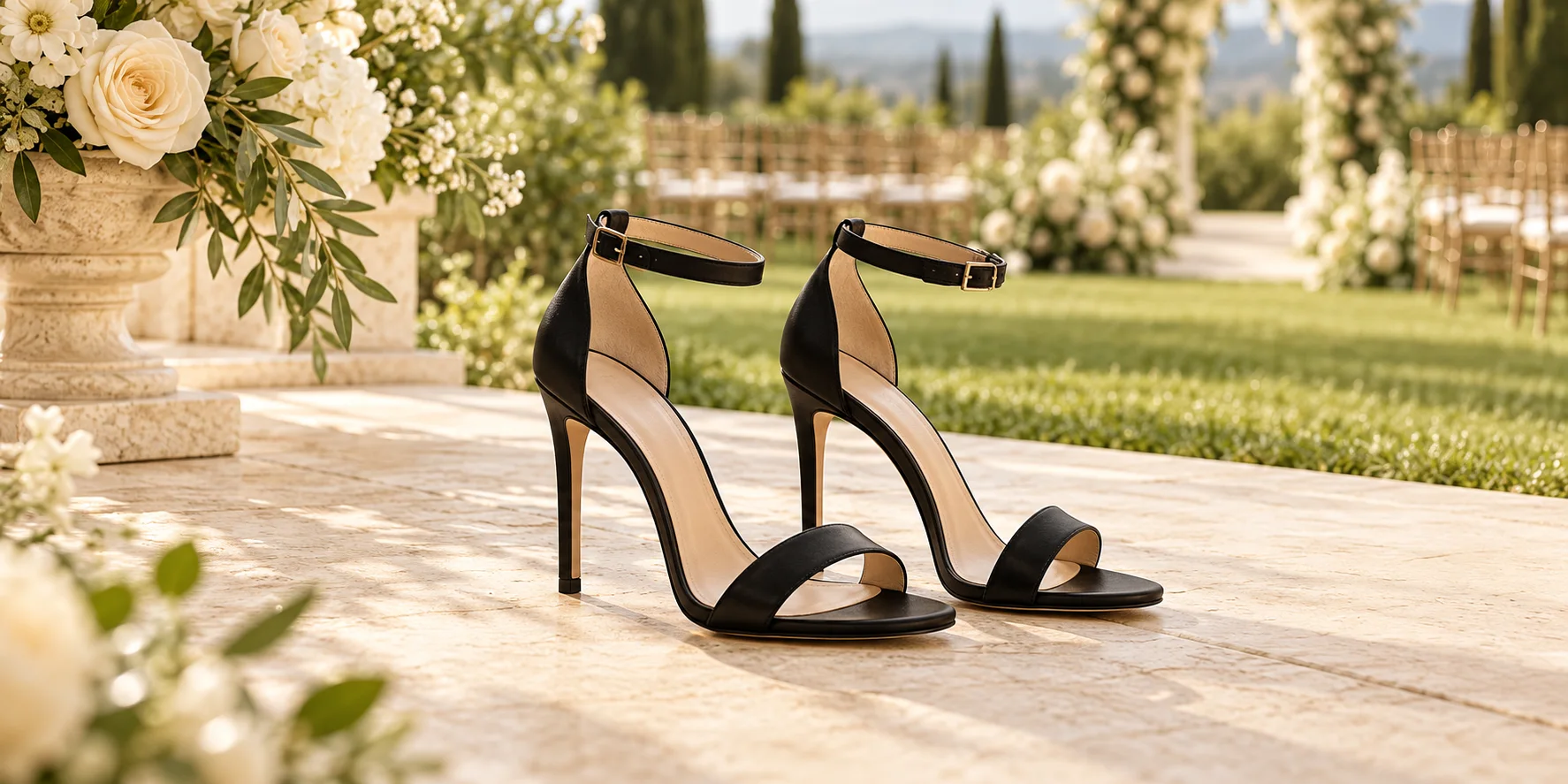
You can wear stilettos to an outdoor wedding when the surfaces and your own fit check support that choice. For a ceremony on soft grass, sand or uneven ground, plan a different pair for that part of the day. Save the fine heels for a suitable firm surface rather than relying on a heel protector to make every route work.
“Outdoor” might mean a paved courtyard, a lawn, a beach or several of those in one afternoon. Before choosing sandals to match your dress, find out where you will actually walk and stand. The invitation’s dress code and the ground under your shoes answer different questions.
Ask About the Whole Route
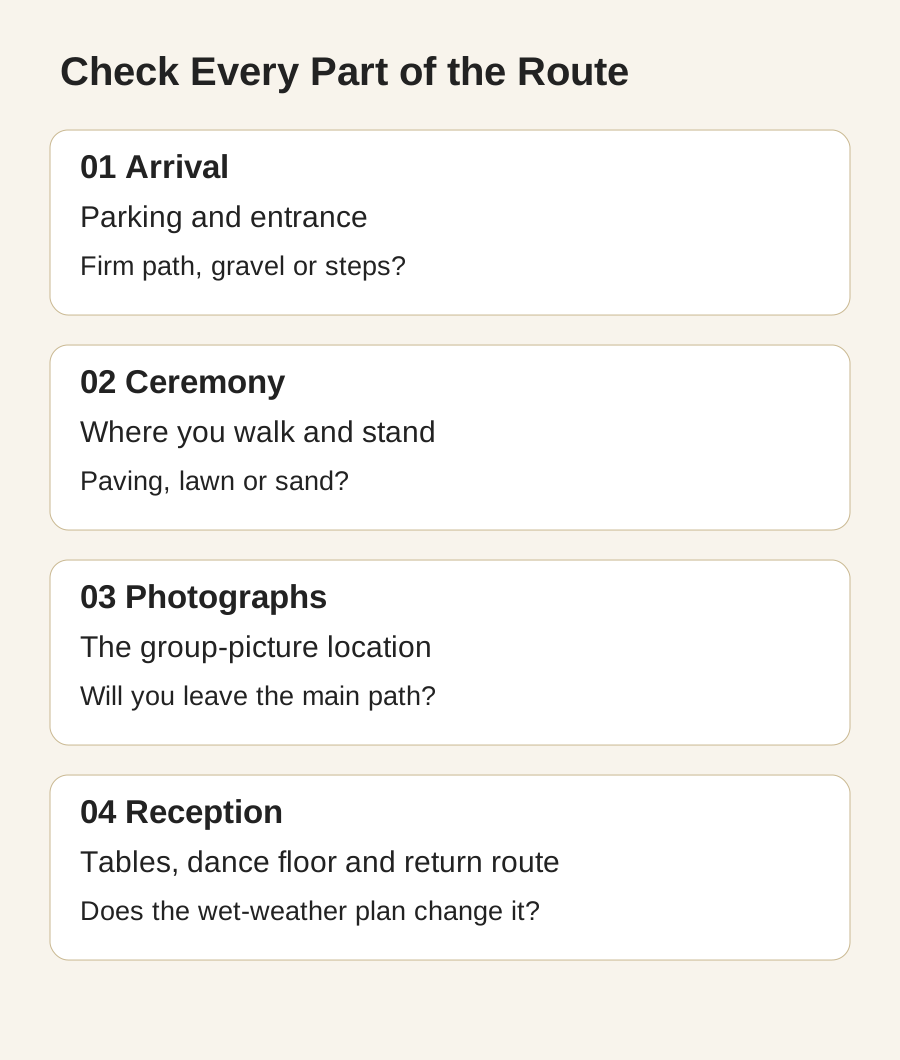
A photograph of the reception terrace does not show the walk from the parking area or the lawn used for group pictures. Ask the host or venue about the arrival path, ceremony seating, photographs, reception and restrooms. You do not need a detailed site survey; a short description of the surfaces is useful.
Try asking: “Will guests need to cross grass, gravel or decking, and is there a firm path between the ceremony and reception?” Also ask whether the wet-weather plan changes that route. A tent may cover a lawn without providing a solid floor.
Include standing time in your decision. A short walk across a lawn followed by a long ceremony on it is different from stepping straight onto a paved terrace. If the surface remains unknown, choose footwear that does not depend on a narrow heel tip staying above soft ground.
Choose for the Surface, Then the Outfit
The Knot’s outdoor-wedding shoe guide favors broader ground-contact areas for grass and advises checking heel protectors with your shoes before the event. Its shopping list is not a fit guarantee; use the ground-surface distinction to narrow your own choices.
- Firm, even paving: Stilettos may be an option if the pair fits you and you can move naturally in it. Check the route for steps, gaps and slippery areas rather than treating all paving as identical.
- Grass or soft soil: Avoid planning around a bare narrow heel tip. Consider flats or a broader-based shoe you have tried, or change shoes before reaching the lawn.
- Loose gravel or uneven cobblestones: Think about the gaps and changing footing, not only whether the ground is soft. Choose a pair you can manage on that route; a cap on a stiletto does not level it.
- Sand: Plan footwear specifically for the beach section. A fine heel with an accessory is not a substitute for a suitable beach shoe.
These are selection checks, not promises that any shoe category is safe on every surface. Wet conditions, slopes and your individual fit still matter. Do not force a pair that feels unsteady just because it matches the dress.
Do Not Confuse a Front Platform with a Wider Heel
A platform under the forefoot and a broad heel at the back are separate features. A sandal can have a substantial platform and still finish in a very narrow stiletto tip. Inspect the rear heel instead of assuming that the word “platform” solves the grass question.
The Double-Buckle Platform Stiletto Sandals illustrate that distinction: their details list a raised front platform and a tall stiletto heel. They are a construction example, not a recommendation for a lawn ceremony. Our platform and non-platform heel guide explains the separate height measurements.
Likewise, a lower heel is not necessarily a broader heel. Look at the part that meets the ground. A buckle or extra ankle strap changes how the shoe fastens; it does not change the shape of that contact point.
Treat Heel Protectors as a Conditional Option
A heel protector is an accessory fitted around the heel tip to give it a broader base. It is worth investigating for a specific shoe and surface, but compatibility needs checking before the wedding.
Read the maker’s sizing method and restrictions. Clean Heels’ sizing guide, for example, asks for the widest part of the heel tip, including the diagonal where relevant. Its fitting warning cautions against forcing an incorrectly sized stopper onto a heel. Measure the heel tip as directed rather than choosing by your shoe size, and check whether the heel’s shape and finish are suitable. Do not force a protector onto a heel or assume that one labeled “universal” is right for every design.
Try an appropriate accessory in advance according to its instructions. If it shifts, feels uneven or marks the shoe, stop using it and seek the maker’s advice. Even a correctly fitted protector does not establish grip on wet paving, fill gaps between boards or make a loose sandal fit. If the ground is very soft or the route is uncertain, changing shoes is the more straightforward plan.
Make a Two-Shoe Plan That You Can Actually Use
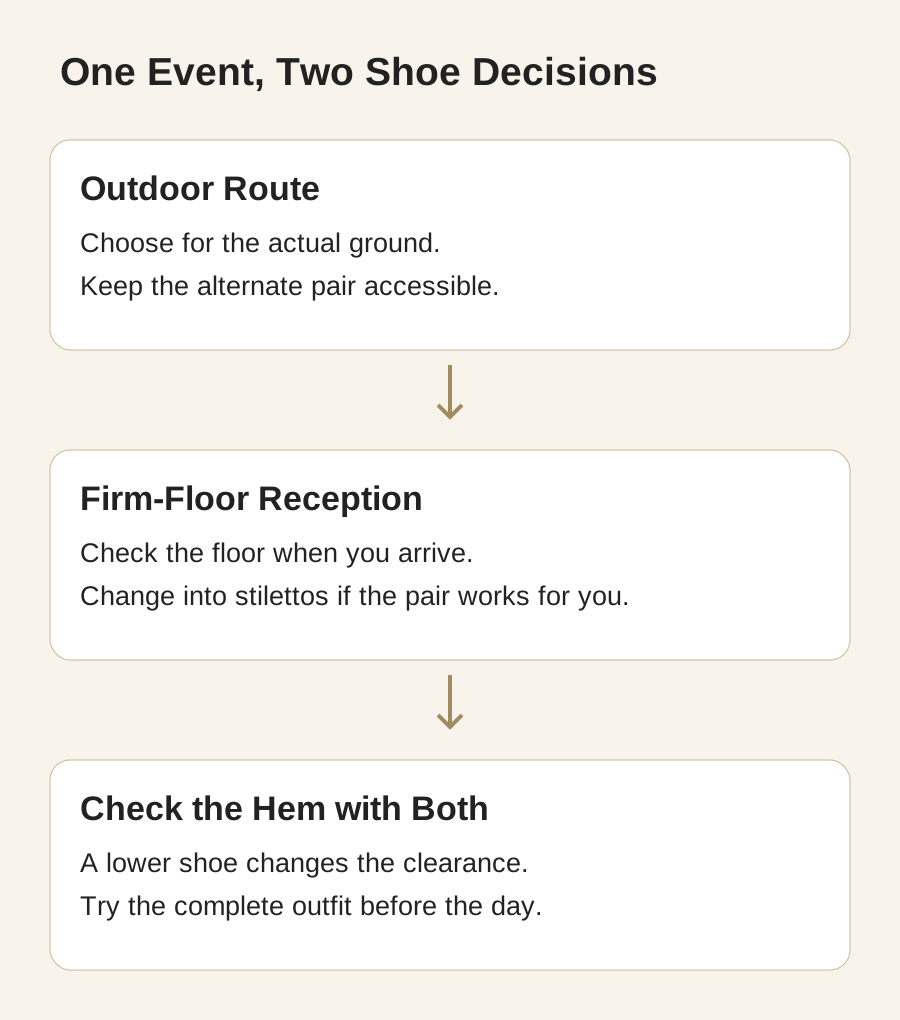
You do not have to choose one pair for every part of the event. You could arrive in a dress-appropriate pair suited to the outdoor route, then change into stiletto sandals at the reception once you have seen the floor. The change works best when it is planned before you leave home.
- Choose the change point. Look for a place to sit before the difficult surface, not halfway across it.
- Keep the second pair accessible. A bag left in a distant car may be of little use between the ceremony and photographs.
- Try the outfit with both pairs. A long hem that clears the floor in high heels may drag when you switch to flatter shoes. Adjust the outfit or choose another combination.
- Check both pairs on both feet. Fasten them normally and walk, turn and sit during an allowed try-on. Follow the seller’s return conditions.
For the indoor look, our strappy-heels styling guide can help you decide how much ankle detail to show. For a new purchase, use the measurement guide and the exact product’s size chart. Neither a familiar size label nor a venue description replaces trying the shoes.
Before You Leave
Recheck the host’s dress code, the route and the weather plan. Pack the alternate pair where you can reach it, and make sure your hem works with the intended changes. If conditions differ when you arrive, change the footwear plan rather than trying to make the ground fit the shoes.
The useful question is not whether stilettos are allowed outdoors in general. It is whether this pair, on your feet, works for the actual surfaces between arrival and departure.